Windows Service
Installing A Service
If you wish to install either FileFlows Server or FileFlows Agent as a Windows service, follow this guide.
The service runs the same launcher as the Start Menu shortcut (FileFlows.Server.exe or FileFlows.Agent.exe), started with --service. This runs FileFlows without the tray icon, and automatic updates work the same as they do when FileFlows is run from the tray.
Close FileFlows from the tray icon before installing the service, only one instance can run at a time.
Download NSSM - the Non-Sucking Service Manager and extract the zip.
Open a command prompt in the same folder as
nssm-(version)\win64\nssm.exe
In the paths below, replace User with your Windows user name. FileFlows is installed to C:\Users\User\AppData\Roaming\FileFlows by default.
Use the full path, not %AppData%. A service does not run as your user, so %AppData% would not point to where FileFlows is installed.
- Server
- Agent
nssm install FileFlows
Application
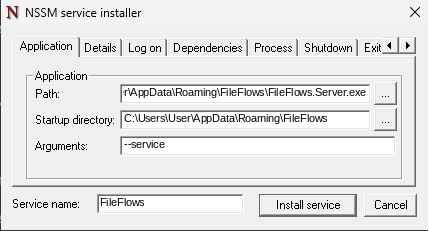
Path
C:\Users\User\AppData\Roaming\FileFlows\FileFlows.Server.exe
Startup directory
C:\Users\User\AppData\Roaming\FileFlows
Arguments
--service
Then click Install Service.
To install it without the dialog instead:
nssm install FileFlows "C:\Users\User\AppData\Roaming\FileFlows\FileFlows.Server.exe" --service
nssm set FileFlows AppDirectory "C:\Users\User\AppData\Roaming\FileFlows"
nssm install FileFlows-Agent
Application
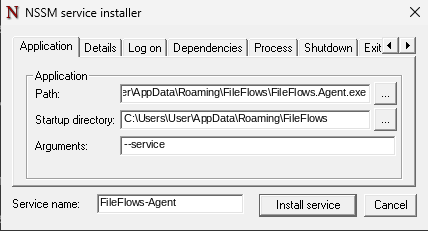
Path
C:\Users\User\AppData\Roaming\FileFlows\FileFlows.Agent.exe
Startup directory
C:\Users\User\AppData\Roaming\FileFlows
Arguments
--service
Then click Install Service.
To install it without the dialog instead:
nssm install FileFlows-Agent "C:\Users\User\AppData\Roaming\FileFlows\FileFlows.Agent.exe" --service
nssm set FileFlows-Agent AppDirectory "C:\Users\User\AppData\Roaming\FileFlows"
The service runs as the Local System account by default, which cannot access mapped drives or network shares that need your credentials. If your libraries are on a network share, set the account to run as on the Log on tab, and use UNC paths (for example \\server\share\movies) instead of mapped drive letters.
Starting The Service
The service starts automatically when Windows starts. To start it now:
nssm start FileFlows
Or for the Agent, nssm start FileFlows-Agent.
Uninstalling A Service
To uninstall a service created with NSSM.
- Server
- Agent
nssm.exe remove FileFlows
nssm.exe remove FileFlows-Agent