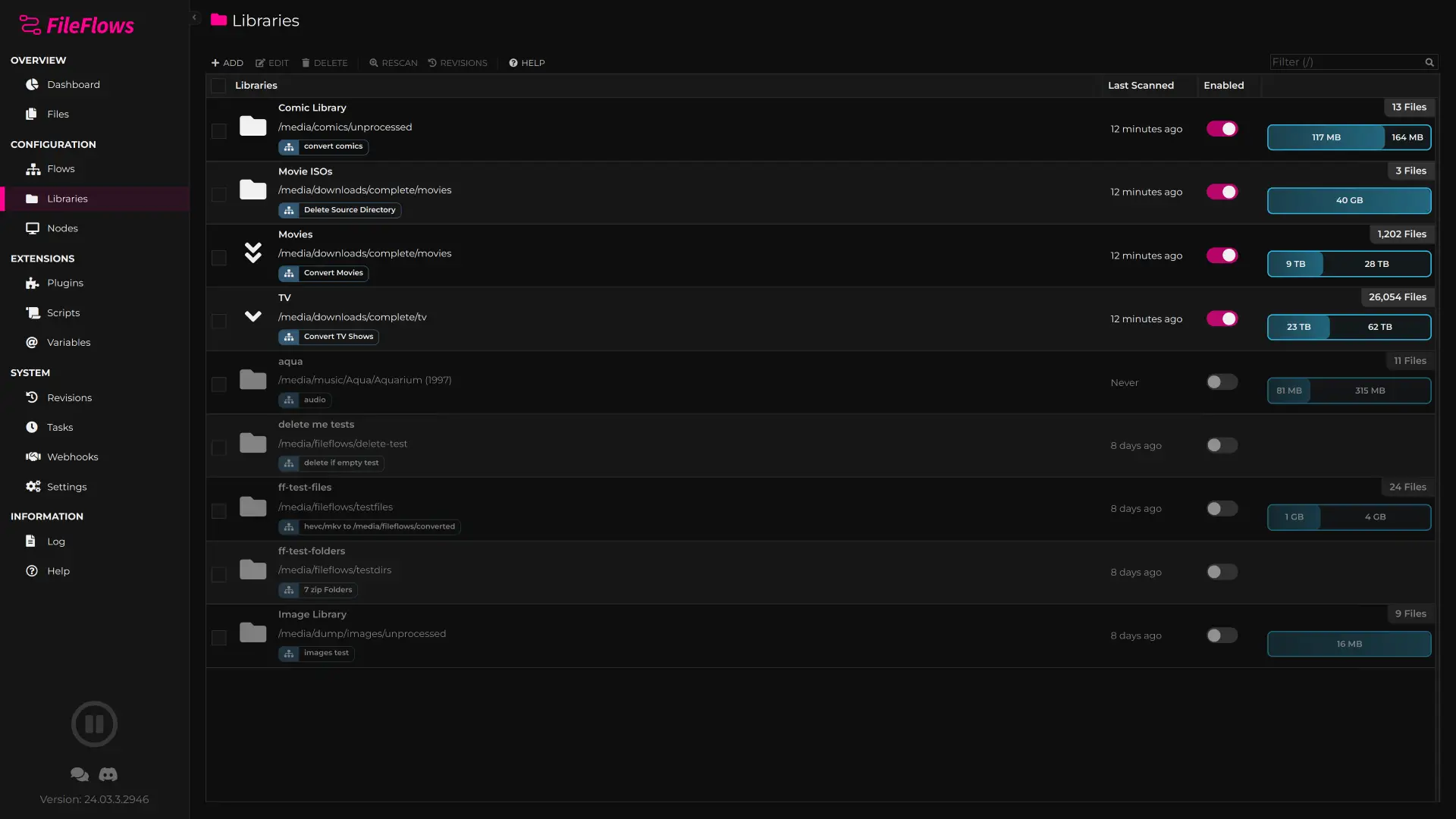
Libraries
Libraries are where files are stored and the directories that will be scanned for processing.

General
- Name
- The name of the library.
- Path
- The directory path to scan for files.
- Flow
- The flow to use when processing files in this library.
- Priority
- The priority with which files should be processed. Higher priority libraries are processed first.
- Processing Order
- The order in which files will be processed by this library.
- Scan Interval
- The time interval at which a library scan will be triggered. File system events are monitored for real-time detection, but scheduled scans ensure complete coverage.
- Hold Minutes
- Optionally hold any files found in this library for this amount of minutes before processing them.
- Enabled
- Whether the library is active and should be scanned.
File Types
Configure which file types to scan for and set filtering options.
- File Types
- Select the type of files this library should process (Audio, Video, Image, or Custom).
- Extensions
- Manually specify file extensions to process. Only visible when File Types is set to Custom.
For Video libraries:
- Video Codecs
- Select the specific video codecs this library should process.
- Resolutions
- Select the video resolutions this library should process.
- Duration
- Filter by video duration range.
- Skip Already Processed
- When enabled, files that have already been processed will not be scanned again.
For Audio libraries:
- Audio Codecs
- Select the specific audio codecs this library should process.
- Duration
- Filter by audio duration range.
For Image libraries:
- Image Codecs
- Select the specific image formats this library should process.
- Min/Max Width and Height
- Filter by image dimensions.
Video Codecs, Resolutions, Processing Order, Audio Codecs, Image Codecs, Priority, and Max Runners require a license.
Conditions
Configure file detection conditions to filter which files are added to the library.
- Filters
- Optional list of inclusions to run against the full name of the files.
- Exclusions
- Optional list of exclusions to run against the full name of the files.
Detection conditions:
- File Creation
- Filter files based on their creation time.
- File Last Written
- Filter files based on when they were last modified.
- File Size
- Filter files based on their size.
Schedule
Configure when the library will be active.
- Schedule
- The library scanner will not run against this library nor will any files be processed outside of the schedule.
- Max Runners
- The maximum runners that can process files in this library at one time. Set to 0 for unlimited.
Advanced
- File Detection Interval
- The amount of time in seconds to wait to recheck the file size during the library scanner. Useful if another application may be writing to a file in chunks.
- Exclude Hidden
- When enabled, hidden files and folders will not be scanned.
- Folders
- If this library processes Folders instead of Files.
- File System Events
- Specifies whether to monitor file system events for real-time file detection.
- Skip File Access Tests
- When enabled, the library will not test if it can read or write to files before adding them to the queue.
- Top Level Only
- Only scan files in the root of the directory and not search subfolders.
- Wait Time
- The number of seconds that must have passed since the last file change before the folder is scanned.
- Downloads Directory
- A special directory where if a successfully processed file is rediscovered, it will automatically be reprocessed.
- Ignore Size Changes
- If enabled, file size changes will not trigger reprocessing.
Reprocess
To reprocess all files within a library, right-click on the selected library or libraries and choose the Reprocess option from the context menu.
This action will move all processed items, including failed items, back into the unprocessed queue. It will not rescan the library or remove any items.
Reset
To reset a library, right-click on the selected library or libraries and choose the Reset option from the context menu.
This does not delete or modify any files or folders on disk. Only FileFlows' internal records are affected.
This action removes all file entries from the FileFlows database for the selected libraries and then rescans them for new items.
All existing library entries will be lost, and this action cannot be undone.